Energ’Ethic podcast – Vice-Chair Julie Kjestrup (VELUX)

Our Vice-Chair Julie Kjestrup (Head of Policy and Thought Leadership for VELUX) is the last invitee of the Energ’Ethic podcast hosted by Marine Cornelis.

Listen to the full conversation here.

Buildings Directive: Parliament votes for action on cutting energy bills

By adopting its EPBD position, the European Parliament has demonstrated its commitment to slashing energy imports, improving millions of homes, lowering this way the increased energy poverty rates.

Read full press release here.
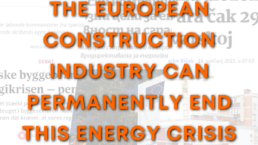

Business leaders co-sign op-eds throughout Europe calling for an ambitious EPBD

Leading companies in the construction market throughout the European Union highlight in respective co-signed op-eds on national media the key role the Energy Performance of Buildings Directive (EPBD) can play to cut the dependence of homes and buildings in Europe on imports of fossil fuels.

The following two elements are highlighted:

  • The renovation of F/G level public buildings to B/C will signify a decrease in final energy consumption by 90%.
  • Each billion invested to energy efficiency can create 18,000 jobs.

Op-eds have been published in the following countries:


Nominate your candidate for the C4E Champion Award

We are looking for the Central and Eastern European energy efficiency champions!

The C4E Champion Award recognises the contribution of public officials in the CEE region to progressing energy efficiency policies in their country or region.

The Award ceremony will take place at C4E Forum 2023.


BUILD UP interview - Julie Kjestrup (REC Vice-Chair)

“Energy efficient renovation is about meeting climate targets and lowering energy dependence, but also about delivering on social benefits” says Julie Kjestrup (Vice-Chair of the Renovate Europe Campaign) on “Building Conversations Up” (BUILD UP)


Public buildings must lead the way in reducing fossil fuel imports

Public buildings must lead the way in reducing fossil fuel imports

Your government is vocal and determined in the need to reduce fossil imports and boost the EU’s energy independence. The Energy Efficiency Directive (EED) represents an important opportunity to progress on this goal, by reducing the energy demand, and therefore the energy bills, of our public buildings. We are seriously concerned however about recent developments in the EED negotiations.

In my capacity as Director of the Renovate Europe Campaign, I urge you to demonstrate leadership and a commitment to reducing fossil fuel imports by supporting a robust Article 6 on public buildings at the final EED trilogue meetings on the 2nd and 9th of March.

As you know, 40% of all energy consumed in the EU is swallowed by Europe’s leaky buildings. Energy renovation is the long-lasting, sustainable solution to the energy, social and climate emergency we face.

Public buildings must lead the way, not only to set the tone and raise awareness, but also in order to pave the way towards achieving the 2030 and 2050 climate goals. Public buildings play a key role in preparing the market for the wider uptake as their diversity makes them a microcosm of what will need to happen in other buildings segments.

We therefore call on you to ensure an effective and impactful Article 6 by:

  • Not supporting the alternative approach:
    The scope and impact of Article 6 is already very diluted through a series of exemptions, including the possibility to renovate certain types of buildings (such as historic buildings) at lower performance requirements, to limit the renovation only to buildings owned by public bodies (with incentives to those occupied) and a loose interpretation of the definition of ‘public bodies’. Exempting also social housing (something Renovate Europe does not support given that social housing harbours the most vulnerable in society, mostly living in the coldest homes with the highest energy bills) undermines Article 6 even further. Allowing public authorities the alternative possibility to renovate a building in a staged-deep approach with a Building Renovation Passport by 2040 to achieve similar savings will only delay action. The urgent need for action on buildings in the midst of the energy crisis could not be more clear – public authorities must take responsibility and show leadership.
  • Ensuring ZEB level depth for Article 6:
    Faced with an energy and climate imperative, the accurate level of renovation depth is crucial for the buildings to be renovated in Article 6. Renovating to ZEB level (and not nZEB level) must be the threshold, also to stay in line with developments in the Energy Performance of Buildings Directive (EPBD).

Your country’s input at the final EED trilogue meetings will be decisive in translating the political discourse on slashing energy imports into tangible action.

A robust Article 6 must place public bodies as the front-runners to remain credible with citizens. Watering down the renovation obligation for public bodies any further would severely undermine the exemplary nature of public authorities, at a time when citizens are looking for leadership out of the energy crisis and climate emergency.

I remain at your disposal if you have any questions, and would of course be happy to discuss further if needed.

Yours sincerely,

Adrian Joyce
Renovate Europe Campaign Director

Download PDF here.