

Renovate Europe co-signs a joint letter on MEPS
Renovate Europe, alongside 26 other leading industry players, NGOs, think tanks and investors, co-signs a joint letter calling Members of the European Parliament to adopt ambitious Minimum Energy Performance Standards (MEPS) in the EPBD recast.

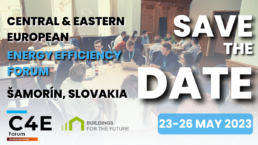
Slovakia to host the C4E Forum 2023
The Renovate Europe Campaign (REC), with the support of our national partner Buildings for the Future, is delighted to announce that we will organise the next C4E Forum in Slovakia from the 23rd to the 26th of May 2023.

REC Newsletter - Summer 2022

Welcome to Renovate Europe’s newsletter!
Here are some highlights from the past few months leading up to the summer break.
These include: Recommendations on how to effectively use Cohesion Funding towards energy renovation, Ongoing work monitoring the National Recovery and Resilience Plans, as well as Outreach to EU Energy Ministers about the importance of a robust article 6 on public buildings in the EED.
Renovate Europe recent initiatives also included a webinar on Unlocking the role of the Banking Sector in the Renovation Wave with PositiveMoney, an event on Skills in the MFF with Energy Cities and EFBWW, and our support for the Energy Cities campaign “More local staff to achieve climate transition”.
We are also very pleased to announce the launch of Renovate Bulgaria which becomes our new Bulgarian National Partner.
Thank you to all our Partners for their assistance in our activities!
Read the full Newsletter here.

Spend wisely: How to use Cohesion Funding for Energy Renovation

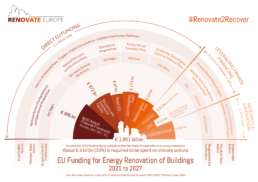
The European Regional Development Fund (ERDF), Cohesion Funds (CF) and the European Social Fund Plus (ESF+) can make a big difference for buildings renovation. But the Operational Programmes must be designed and implemented in a way that creates and sustains a renovation market for the longer term, beyond the “cliff-edge” end of the programming period.
We strongly urge Member States to consider the Key Recommendations on how to channel MFF funding effectively towards energy renovation in the Operational Programmes, namely by:
- Ensuring coherence with EU long-term climate objectives
- Avoid programmes funding single measures
- Scale the aid according to quality and ambition of the renovation project
- Attracting and leveraging private financing
- Limit the use of grants
- Favour lower support intensity
- Modulate the level of the aid rate to increase the leverage of private funding
- Encourage blended finance, combining Financial Instruments with grants
- Establish continuous calls
- Complementing and/or boosting national regulatory and funding initiatives already underway
- Maximise coherence with the national ambitions on buildings
- Facilitate MFF coordination with national funding schemes
- Ensure better coherence/integration of programs for energy renovation with those on renewable energy in buildings
- Streamline the administrative process at national level
- Maximising Programme Implementation
- Ensure sufficient allocation for Technical Assistance
- Ensure MFF-supported training programmes
- Complement the funding with an information campaign
- Better tracking and data collection
- Encourage digitalization
The buildings sector is a sector of enormous economic potential, creating local jobs and reducing citizens energy bills – all the while reducing greenhouse gas emissions and slashing Europe’s dependence on foreign imports.
Read our recommendations more in detail here.

Letter to EU Energy Ministers on Article 6 of the EED
Dear Minister,
At Monday’s Energy Council, your input will be decisive in reaching a General Approach on the Energy Efficiency Directive. In my capacity as Director of the Renovate Europe Campaign, I urge you to consider the importance of a robust Article 6 on public buildings.
Citizens look to their governments for leadership and action. Renovation is a concrete measure that will deliver long-lasting, sustainable solutions to the energy, social and climate emergency we face.
Reducing the energy demand, and therefore the energy bills, of our public buildings is a crucial step in translating political discourse on slashing energy imports into immediate action.
Against an increasingly worrying backdrop of skyrocketing energy bills, it is no longer acceptable that Europe’s leaky buildings account for the largest share of final energy consumption at a high of 40%.
Public buildings must lead the way, as a means of preparing the market and raising awareness, but also in demonstrating a tangible contribution and commitment to real change.
We therefore call on you to ensure that the public sector leads by example with
- An agreement that 3% of public buildings owned by public bodies must be deeply renovated to become nearly zero energy buildings as soon as possible.
- Setting minimum performance standards for all segments of public bodies, including social housing and historic buildings. This will be important in ensuring a just transition, taking into consideration some of the most vulnerable people in society, and will also take account of the technological advances developed to cater for the specificities of historic buildings. Historic buildings can represent up to 30% of the building stock in some countries and already feature as important element in several Long-term Renovation Strategies and National Recovery Plans.
Reducing the energy waste in Europe’s buildings is at the forefront of citizen concerns. Governments must set the tone and lead the way by taking action on public bodies in the Energy Efficiency Directive.
The urgent need for action could not be more clear.
Yours sincerely,
Adrian Joyce
Campaign Director

Op-ed: Spend wisely: Use cohesion funding for energy renovation (Euractiv)
Published by Euractiv on: 20 June 2022 | The EU budget can go a long way toward helping member states achieve higher ambition on energy-efficiency renovation of buildings. But the money must be spent wisely, writes Adrian Joyce.