

Sourcing Private Financing to Boost Energy Renovation in the CEE Region

Sourcing private financing to boost energy renovation in the CEE Region
New approaches to financing that will support upscaling of energy renovations
Microsoft Teams
October 20, 10:00 – 11:15 (CET)
How can we finance a faster and more ambitious renovation wave across Central and Eastern Europe?
The second webinar in the series co-organised by Renovate Europe and RenoCEE will explore how financing models are evolving, from traditional 100% subsidy and grant schemes towards approaches combining public support with loans and private finance.
Experts from the European Commission, the Hungarian financing hub, the Czechia Ministry of Industry and Trade and the Polish National Fund for Environmental Protection and Water Management will discuss how private financing can help deliver a steady increase in both the rate and ambition of energy renovation across the CEE region.
The webinar will also explore how higher renovation ambition can unlock greater energy savings and support more comprehensive building renovations.
AGENDA
Introduction
Adrian Joyce, Director of the Renovate Europe Campaign
Peter Robl, Representative, RenoCEE
The European Energy Efficiency Financing Coalition and its national hubs – focus on CEE Region
Carlos Sanchez Rivero, Team Leader, Financing Energy Efficiency in DG ENER
National experiences with setting up a Financing Hub
László Bihari, Chair of the Hungarian National Hub
Transforming existing national programmes away from full subsidies
- Terézia Kratochvíl Marušáková, Ministry of Industry and Trade, Czechia
- Marta Babicz, National Fund for Environmental Protection and Water Management, Poland
Q&A
Conclusions


Securing Ambition on Energy Renovation in the CEE Region Webinar
Securing Ambition on Energy Renovation in the CEE Region
Microsoft Teams
October 7, 10:00 – 11:15 (CET)
Organised by Renovate Europe with the support of RenoCEE, this webinar looked at the status of the preparation of National Building Renovation Plans (NBRPs) in the CEE Region.
It explored how to secure ambition in the NBRPs, going beyond simple compliance with the requirements of the Energy Performance of Buildings Directive (EPBD).
We heard directly from EU- and national-level stakeholders involved in monitoring, analysing and implementing the EPBD, providing participants with a reliable overview of the current state of play and the key challenges ahead.
The webinar equipped participants with a better understanding of how they can contribute to strengthening the final NBRPs, while highlighting good practices and approaches that can be replicated across the CEE region.
An interactive Q&A session also provided participants with the opportunity to engage directly with our speakers and address their questions.
AGENDA
Introduction
Adrian Joyce, Director of the Renovate Europe Campaign
Peter Robl, RenoCEE
The EPBD implementation challenge and progress to date
Pau Garcia Audi, Team Leader, DG ENER, European Commission
Analysis of submitted NBRP’s – focus on the CEE Region
Quentin Jossen, Associate Partner, CLIMACT
Facing the EPBD implementation challenge – national approaches to preparation of NBRPs
- Anca Ginavar, Ministry of Development, Public Works, and Administration, Romania
- Irena Križ Šelendić, Ministry of Physical Planning, Construction, and State Assets, Croatia
Q&A
Conclusions

National Building Renovation Plans Webinar
National Building Renovation Plans Webinar
Microsoft Teams
September 22nd, 10:00 – 11:30 (CET)
Organised by Renovate Europe, this webinar brought together representatives from national ministries, energy agencies, the European Commission and technical experts to explore the development of NBRPs in selected countries and what they mean for accelerating building renovation across Europe.
We analysed some of the recently published NBRPs and further explore the findings of “The Delivery Challenge of NBRPs” study developed by CLIMACT as an initiative of Renovate Europe and nine other organisations.
With the Energy Performance of Buildings Directive now in its implementation phase, National Building Renovation Plans will be a key tool to align stakeholders and turn Europe’s building energy goals into measurable savings.
Drawing on best practices from the Danish and Spanish plans for other EU countries, and on the expertise of the European Commission and CLIMACT, the speakers guided us through all aspects of national building renovation plans, from planning to implementation and delivery.
An interactive Q&A session provided an opportunity to address our speakers directly.
Watch the recording and hear directly from the experts shaping Europe’s renovation plans!
AGENDA
Introduction
Rémi Collombet, Secretary General, Efficient Buildings Europe
European Commission’s Assessment of the First Draft of NBRPs
Julien Tami, Policy Officer, DG ENER, European Commission
“The delivery challenge of National Building Renovation Plans” Study
Quentin Jossen, CLIMACT
Q&A
From Concept to Practice: National Building Renovation Plans Case Studies
- The Danish National Building Renovation Plan
Nina Helene Hilbard, Teamlead, Energy Efficiency and Data, Danish Energy Agency
David Herrmann, Head of Division, Center for Electrification, Danish Energy Agency
- The Spanish National Building Renovation Plan
Ainhoa Díez de Pablo, Director of the Division of Innovation and Sustainability in Building of the Ministry of Housing and Urban Agenda, Ministry of Housing and Urban Agenda - The Portuguese National Building Renovation Plan
João Simões, Technical Specialist and Team Leader, ADENE – Agência para a Energia
Q&A
Conclusions
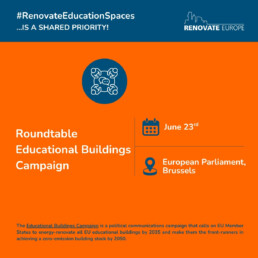
Roundtable on Educational Buildings Campaign
The Renovate Europe Campaign launched its Educational Buildings Campaign in October 2025, calling on all EU Member States to make educational buildings frontrunners in the transition towards a zero-emission building stock by 2050 and to commit to their deep renovation by 2035. This can be achieved through the inclusion of dedicated measures for educational buildings in National Building Renovation Plans (NBRPs), which are currently under preparation.
As part of this initiative, a private roundtable discussion was held at the European Parliament in Brussels on 23 June, hosted by MEP Marcos Ros Sempere.
The event brought together educators, students, policymakers, and experts to discuss the future of Europe’s educational buildings. Participants explored the role of educational infrastructure in achieving Europe’s climate and energy objectives, while highlighting the benefits of deep renovation for learning environments, health, comfort, and energy performance.
During the discussion, the findings of the Renovate Europe Campaign’s NBRP Study, conducted in collaboration with CLIMACT and other partner organisations, were presented alongside inspiring case studies from across the European Union. The conversation was further enriched by contributions from representatives of student and teacher associations, who shared firsthand experiences and perspectives on the priorities for future educational buildings.
Agenda
Introduction
Moderation of the Roundtable and presentation of the Renovate Europe Educational Buildings Campaign by Adrian Joyce, Director of the REC.
Policy Context
- European Commission perspective by Robert Nuij (Head of Unit) from DG Energy on how member states can emphasise Educational Buildings in their National Building Renovation Plans (NBRP’s). This will include and overview of which member states have already included educational buildings in their draft NBRP.
- Presentation by Quentin Jossen of key findings relevant to our call from the Climact Study on NBRP’s supported by the REC and other stakeholders.
Presentations from Stakeholders
- Experiences from a student representative organisation – Andra Kruna Ramsay, SUPEUS (HR)
- Perspective of parent’s association – Bostjan Bobic, European Parents Association (EPA)
- Sustainability assessment tool for schools – Simon Polomé, Fontana Design
- Action at national level – Croatian Communication Campaign – Andelka Toto Ormuz, HUPFAS, REC National Partner, Croatia.
Exchanges between audience and speakers
An open exchange with all participants will start with an intervention by Marcos Ros Sempere. Other MEP’s present will be prioritised during the exchange which will last about 30 minutes.
Conclusions
Marcos Ros Sempere (MEP) to share his impressions of the exchanges and to provide brief closing remarks
INTERVIEWS WITH OUR GUEST SPEAKERS
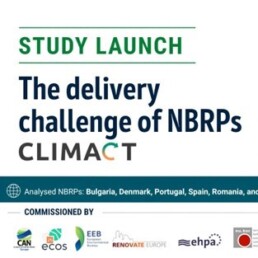
New study on National Building Renovation Plans published

Renovate Europe, together with other 9 partners, has published a new study, “The Delivery Challenge of NBRPs”, examining the current state of National Building Renovation Plans across Europe. The study was developed by CLIMACT and currently covers: Belgium-Wallonia, Denmark, Portugal, Spain, Romania and Bulgaria.
Buildings remain one of the key areas for achieving the energy transition, and the quality and ambition of national renovation strategies will play a decisive role in meeting EU energy and climate targets.
You can access the complete analysis, including methodology and detailed findings, here:

A budget to scale up energy renovations in the EU
As discussions on the European Union’s Next Multiannual Financial Framework move forward, Renovate Europe is publishing its position paper on the MFF.
Shaping the EU budget for 2028–2034 is a critical opportunity to deliver on competitiveness, affordability, resilience and energy security, and buildings must be at the heart of this effort.
Why? Because energy renovation is one of the smartest investments Europe can make:
➢ Buildings account for ~40% of EU energy use and 36% of emissions
➢ Every €1 invested in energy efficiency can generate up to €12 in energy savings
➢ Renovation reduces energy bills, strengthens energy independence, and improves people’s quality of life
Yet the investment gap remains significant, and the next MFF must help bridge it.
In this context, Renovate Europe calls for:
➢ A dedicated building renovation priority in National and Regional Partnership Plans
➢ An EU Renovation Loan Facility under the European Competitiveness Fund/InvestEU architecture
➢ A performance and tracking methodology that captures real energy savings, social impact and delivery quality.
Beyond funding, the next EU budget must also support implementation on the ground, from technical assistance to local delivery capacity, to turn ambition into real projects.