
Unlock the Power of Insulation
At ROCKWOOL we emphasize our commitment to sustainability and climate care though various initiatives aimed at reducing energy consumption and greenhouse gas emissions. Our insulation products are designed to significantly enhance energy efficiency in buildings. By improving thermal performance, our stone wool products can reduce energy needs for heating and cooling by up to 70-90%, allowing buildings to save more energy than what is consumed during the insulation’s production within just a few months. The stone wool insulation sold in 2023 is projected to save over 818 TWh of energy over its lifetime, equivalent to the annual electricity use of more than 68 million homes.
Andrzej Kielar (Managing Director ROCKWOOL CEE) repeatedly emphasized during the discussions held at Renovate Europe Day 2024 that, given the many challenges of the modern world, we cannot afford to do nothing about deep renovation of building stock. Let us therefore take advantage of the unique opportunity presented by the wave of building renovations to improve the comfort of our lives and have a positive impact on the natural environment now and in the future.
Our involvement into energy efficiency aligns closely with the objectives of EPBD directive. It plays a crucial role in supporting the EU net zero efforts by establishing energy efficiency and emissions standards for buildings. Why is it important? Let’s recall basic facts. Buildings use about 40% of global energy, 25% of global water, 40% of global resources, and they emit approximately 1/3 of GHG emissions.
We spend a large part of our lives, work and time after work in buildings. That is why they are so important to us and the climate. Never before has so much attention been paid to the building stock. The implementation of the EPBD is a unique opportunity for all of us to make our homes, workplaces and places of rest healthy, environmentally friendly and financially efficient. To achieve this, it is enough to once and effectively perform thermal modernization of buildings that need it. The solutions we develop at ROCKWOOL are those that stay with buildings throughout the period in which we use them. Very often, the modernization of building stock is viewed through the prism of costs rather than benefits. And there are many, as we will outline later in this article.
Social benefits of thermal modernization
There is nothing more valuable than health. Healthy people live and work in healthy buildings, because only such buildings provide the right conditions for life. And what are the facts? 75% of buildings in the EU are low energy buildings. 85% of them were built before 2000. These buildings will remain in our landscape for a long time. And it is worth taking care of them so that they provide us with warmth in winter and protect us from increasingly frequent heat waves in summer. Underheated and overheated buildings can be a source of illness and significantly reduce the comfort of life and work.
Environmental benefits of thermal modernization
The climate crisis is the greatest challenge of the 21st century and there is no more important global effort than the one related to reducing GHG emissions. Without decarbonization of the building stock, the energy transformation and achieving climate neutrality will not be effective. Increasing the energy efficiency of buildings and thus reducing energy demand also means reducing harmful smog, which contributes to several hundred thousand premature deaths in the EU every year.
Economic benefits of thermal modernization
As mentioned earlier, deep thermal modernization translates into lower energy consumption and thus a significant reduction in the bills related to the maintenance of individual buildings. This is particularly important in view of the alarming statistics on energy poverty in the EU. Approximately 50 million households in the EU are estimated to live in energy poverty, struggling to afford adequate energy services necessary for heating, cooling, and lighting their homes. This represents about 14.6% of EU households reporting inadequate energy expenditures.


C4E Forum 2025 - Save the date

SAVE THE DATE!
20-23 May 2025, Cavtat, Croatia.
The C4E forum, a bi-annual event, is meant to build and strengthen Central and Eastern Europe’s energy efficiency community.
C4E Forum 2025 will take place between 20th and 23rd May 2025 in Cavtat, Croatia.
Further information: C4E Forum – What is C4E Forum?

Endorse Connected Lighting for the Brighter Future
Signify, the world leader in lighting, has an important role to play in the global transition to net zero. Climate action has been central to Signify’s sustainability strategy for more than a decade. We have taken the lead in helping municipalities, businesses, and consumers switch to energy-efficient LED and connected LED lighting— a fast and effective way to make progress toward sustainability goals.
For example, switching all light points in Hungary to connected LED could reduce CO2e emissions by 0.7 Mt and free up 3 TWh of electricity annually, equivalent to the annual energy consumption of 938,000 households.
A human-centric approach to light
Light accompanies us throughout our lives and has a profound impact on our quality of life. It affects our circadian rhythm, quality of sleep, hormone levels, and cognitive performance. We spend an average of 90% of our time in buildings, which is why it is so important, when modernising lighting, to take care of both improving energy efficiency and adapting lighting to people at the same time.
Imagine that we spend 36% of our time at the workplace, so the right lighting is crucial for helping us see well, feel well, and perform well. The digitalisation of lighting and LED technology allows us to create the smart, connected LED lighting systems that – apart from impactful electricity savings up to 80% – can also provide a noticeable improvement in employee well-being by adapting lighting to our circadian rhythm. Moreover, our innovative NatureConnect lighting systems mimic daylight and replicate a view to the sky using light scenes that boost energy levels and help windowless spaces feel in sync with nature, while enhancing the well-being of those in the room.
The business case for enhancing well-being and productivity
The relationship between office lighting and well-being and productivity is undeniable. However, the impact is often underestimated by companies. It is worth realising that the real costs for most companies are related to staffing costs (salaries and benefits), which account for about 90% of typical business operating costs. Improving the well-being and consequently the productivity of employees can have similar, if not potentially greater, financial implications than saving on energy bills. That is why we at Signify believe that the connected LED systems can deliver much more benefits than just electricity savings.
Supporting the EU’s net-zero ambition
The EU aims for an economy with net-zero greenhouse gas emissions by 2050. The Energy Performance of Buildings Directive (EPBD) is one of the critical mechanisms to reach this ambition target. The EPBD requires EU countries to develop long-term renovation strategies that facilitate the cost-effective transformation of existing buildings into much more energy-efficient and livable spaces.
Signify is committed to reach net-zero emissions, through its own products, systems and services. Connected LED lighting as a “technical building system” directly affects building energy consumption and is included in the EPBD’s energy performance calculation. In offices, lighting currently accounts for 17% of all energy use and as much as 40% of electricity use in ambient warehousing, and even more in the school environment. Connected LED lighting is an important contributor to net-zero building renovation plans, especially when integrated with building automation or management systems, referred to in the EPBD as “built-in lighting.” For non-residential buildings, the revised EPBD mandates the use of building automation and controls, including the use of automatic lighting controls with occupancy detection.
A triple win for the climate, the economy, and the society
At Signify, we’ve long believed that well-being is as important as energy efficiency in sustainability considerations. Sustainable buildings are not only more energy efficient, but they are also able to improve the well-being and efficiency of the people working or learning in them. The latest version of the EPBD includes standards for indoor environmental quality (IEQ) recognising that “healthy buildings are vital to the well-being of EU citizens and actively contribute to the productivity, creativity, and safety of their occupants,” as LightingEurope points out.
We believe that thanks to the clear EPBD guidelines for technical building systems, we have a unique opportunity to achieve a triple-win for Climate, Economy and Society in the 21st Century during the upcoming building renovation revolution.
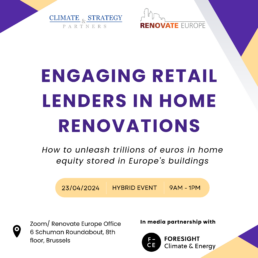
Engaging Retail Lenders in Home Renovations
Join us online or in-person in Brussels at Rondpoint Robert Schuman 6!
Europe is in a race to achieve independence from foreign energy sources, alleviate its citizens from rising energy prices, and to meet its ambitious climate targets. Consuming 42% of energy and being responsible for over one third of energy-related GHG emissions, the decarbonisation of the buildings in the EU is essential to achieve this.
How can we identify which buildings to renovate? How can we provide access to low cost, long-term financing for deep renovations across Europe?
Having business relationships with more than 25 million EU customers, mortgage lenders are the single most connected stakeholder group to Europe’s buildings. As of 2022, mortgages accounted for about 80% of the lending to households. Evidently, the mortgage is the most appropriate and widely used financing tool to provide homeowners investment capital and the opportunity simultaneously to upgrade their buildings to make them resilient against energy shocks, more affordable to run and more comfortable and healthy to live in.
In this event, the Renovate Europe Campaign and Climate Strategy (CS) will present the current state of EU buildings’ renovation efforts and the findings of the latest CS report “Engaging Retail Lenders in Home Renovation”, calling for EU mortgage lenders to play a more proactive role in unlocking the trillions of home equity stored in the buildings owned by their clients through the voluntary uptake of the innovative instrument Mortgage Portfolio Standards (MPS). EU policymakers, buildings experts and finance sector stakeholders will then exchange views on these subjects.
There is growing momentum for Mortgage Portfolio Standards as over a third of the top-30 banks in Europe already have in place a form of voluntary MPS, or equivalent. We look forward to a lively discussion on its potential, design and place within Europe’s decarbonisation efforts. Included in the final version of the Energy Performance Building Directive (EPBD) adopted by the EU Parliament in March 12th of this year, Mortgage Portfolio Standards were defined as:
“Mechanisms incentivising mortgage lenders to establish a path to increase the median energy performance of the portfolio of buildings covered by their mortgages towards 2030 and 2050, and to encourage potential clients to make their property more energy-performant along the Union’s decarbonisation ambition and relevant energy targets in the area of energy consumption in buildings, relying on the definition of sustainable economic activities in the EU Taxonomy.”
Agenda
9:30 AM – 9:40 AM Welcome and Introduction
Adrian Joyce, Director of the Renovate Europe Campaign
9:40 AM – 9:45 AM Ministerial Perspectives on EPBD transposition – Short video
Petr Hladík, Minister of the Environment of Czechia
9:45 AM – 10:10 AM Keynote “The Role of Retail Lenders in Buildings Renovation” and Q&A
Peter Sweatman, CEO Climate Strategy & Partners
10:10 AM – 11:15 AM Panel 1 “Frameworks and financial mechanisms to renovate buildings” and Q&A
Moderated by Sean Carroll, Cities & Buildings Editor, FORESIGHT
- Carlos Sanchez Rivero, DG ENER
- Madeline Schneider, PCAF
- Céline Carré, Saint-Gobain
- Murray Birt, DWS
11:15 AM – 11:30 AM Coffee Break
11:30 AM – 12:45 PM Panel 2 “Climate Risks and Mortgage Portfolios”
Moderated by Vanesa Osuna, Secretariat, Net-Zero Banking Alliance (NZBA)
- Ali Erbilgiç, European Banking Authority
- Dominic Keyzer, ING
- Imène Ben Rejeb-Mzah, BNP Paribas
- Tobias Horn, Deutsche Bank
12:35 PM – 12:45 PM Analysis and key takeaways of Panels 1 and 2
Peter Sweatman, CEO Climate Strategy & Partners
12:50 PM – 1:00 PM Concluding remarks
Adrian Joyce, Director of the Renovate Europe Campaign
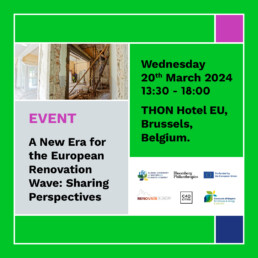
A New Era for the European Renovation Wave: Sharing Perspectives
We are excited to join C40 Cities, the Global Covenant of Mayors for Climate & Energy (GCoM), and the Covenant of Mayors Europe in organising this event, A New Era for the European Renovation Wave: Sharing Perspectives, on the 20th of March in Brussels.
Building renovations are key to improving energy efficiency and energy security, lowering energy bills, creating local green jobs, and improving quality of life. Cities play a key role in delivering the benefits of fossil-free and energy-efficient buildings.
Ahead of the European elections, this event will bring together mayors, deputy mayors, business associations, EU policy makers and key stakeholders to take stock of the progress so far and discuss challenges and opportunities for the future regarding building renovations, following also the update of the European climate and energy legislation.
Agenda
13.30 – 14.00 Registration and coffee
14.00 – 14.10 Welcoming remarks
Benjamin Jance, Head of Research and Innovation at Global Covenant of Mayors for Climate & Energy (GCoM)
14.10 – 14.25 Opening remarks by a keynote speaker
Brian Motherway, Head of the Office of Energy Efficiency and Inclusive Transitions, IEA (online)
14.25 – 15.20 What comes next for building renovations in Europe and the role of the cities
Moderator: Marnie McGregor, GCoM
- Nina Neumann, Team leader, Legislative Development and Enforcement, DG ENER, European Commission
- Peter Dermol, Mayor of Velenje, Slovenia
- Ralf Goldmann, Head of Division, Energy Efficiency and Energy Advisory, European Investment Bank
15.20 – 15.45 COFFEE BREAK
15.45 – 16.45 Enhancing cooperation between cities and stakeholders to boost local action on buildings
Moderator: Oliver Rapf, Executive Director, Buildings Performance Institute Europe (BPIE)
- Andrea Tobia Zevi, Deputy Mayor of Rome for Heritage and Housing, Italy
- Britt Berghs, project coordinator ‘Linkeroever (Left Bank)’ Climate Neutral 2030 for the city of Antwerp, Belgium
- Julien Dijol, Director of Policy, Housing Europe
- Walburga Hemetsberger, CEO Solar Power Europe
- David Ducarme, COO and Deputy CEO Knauf Insulation, Partner of the Renovate Europe Campaign
16.45 – 17.00 Concluding remarks
Adrian Joyce, Renovate Europe Campaign
17.00 Cocktail reception
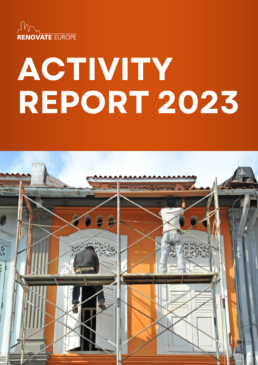
Read our Activity Report 2023
The Renovate Europe 2023 Activity Report is now live!
The Renovate Europe Campaign is the voice for energy renovations. We are committed to creating a platform where our partners can collaborate while bridging the gap between national partners and EU policy makers.
Read it to learn about our Renovate Europe Day in Madrid, our field trip with Commissioner Kadri Simson and her cabinet to renovation sites in Belgium, and the C4E Forum in Bratislava.
Thank you to all of our partners and everyone else who participated in Renovate Europe events last year.